Saturday, June 27, 2009

Yurt Updates

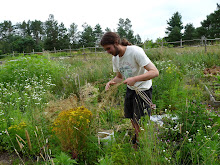
Now that I have the garden reasonably under control I've been working on stringing together the yurt poles into the wall sections. The poles are attached simply by drilling holes spaced exactly 12" apart and tying a short length of twine through the holes. The plan for my 14' yurt calls for three wall sections, two of which I've completed while the third is under construction. After the leaves fall in October I'll cut a nice, straight ash tree in the forest for the tono wheel. I'll cleave it into two planks with a froe which will then be steamed to form the wheel. The roof poles are now oiled and finished, they just need to be cut to length and have their taper made once the tono wheel is complete (the wheel has to come first). I'm hoping the whole thing will be finished sometime this fall, maybe late-October or November.

An interesting concept that I'm building into the yurt is to have at least one pole representing every hardwood species in our forest (minus the rare ones which I wouldn't want to cut and weaker woods like aspen). So far I have red maple, sugar maple, striped maple, white ash, red oak, white oak, paper birch, grey birch, american beech, american elm, linden, speckled alder and black cherry, though the bulk of the poles are ash and maple. It's kind of a symbolic gesture that celebrates the unique diversity of the Acadian forest. When you think about it, a yurt is just about the lowest impact form of shelter when it comes to materials needed from the ecosystem. In all it takes just a few big armloads of biomass (biological wealth) taken out of the forest to fashion a warm, dry shelter (human wealth). Contrast that to a new house. And when the organic based yurt has finally reached the end of its life it can be wholly returned to the earth, the atoms and minerals of which may continue their cycle in a tree, another yurt, a salamander or a human being...

More to come...


Carrying a folded wall section. It folds like an accordion into an easily managed size.
The roof poles (right) spread out while their linseed oil coating dries. Note the smaller diameter wall poles (left) that have been shaped while they were curing to be permanently bent.

Thursday, June 4, 2009

Scything Season

Once again the grasses are almost waist high and rapidly forming their seed heads, like they do every June. The cows having gotten a taste for fresh grass refuse to eat the old hay, so Colin's job lately has been to cut and gather a manger full of grass for Bessie every evening for after her milking. Over the last month Colin has really gotten into scythes. He began in May by insisting on using my full sized one (with a surprising deal of success), until Peter Vido (http://www.scytheconnection.com/) very, very kindly made him a lighter "Colin sized" model. Truly a functional work of art, it makes the cumbersome snath that I made for him seem pretty crude in comparison (but hey, it was only my second attempt!).
Colin even has plans of entering the annual mowing competition this August at Ross Farm. I'm still working with him on his technique but he's about as good as I was when I first started, despite being less than half my age at the time.


Wednesday, June 3, 2009

Lots to update on

I'm finally able to do some writing again after a solid month of garden and farm work. With the help of our WWOOFer Bjoern I got both the seed and food gardens planted weeks ahead of schedule. This year we've got over 60 bean varieties on the go, 40 peas and about 40 tomatoes, among many others. A few of the beans are my own strains that I'm working towards stabilizing. My most promising of these is a striped variation of the pole bean McGrath's Africa. Two years ago in our McGrath's Africa patch I discovered a plant that produced black and white striped seeds in striped green pods, rather than the usual white seeds in leathery purple pods. Last year I grew them out and 95 percent stayed true to type (which is a great rate). If I can stabilize it for a few more years I might even be able to release it as new variety, any name suggestions?


We also planted an acre of Sorghum x Sudangrass in the newly cleared upper field as a green manure crop. Without the ideal equipment of a harrow and some power source to pull it (animal or machine) I ended up broadcast seeding it and then zipping over the field with the rototiller set to it's fastest speed. I set the tines very shallow so that it only mixed the top two inches or so of soil, it worked almost like a rake. A small corner of the upper field we've enriched with tons of manure and we've planted sunflowers, tomatoes, peppers, adzuki beans, chickpeas, millet and corn, as well as a huge patch of squash planted on mounds of manure. We're experimanting with these mounds as a way to stretch what little valuable manure we have. The roots of the squash will be growing in almost pure manure while the vines can sprawl over the less fertile soil around the mounds. We'll see how well it works.


Now that the garden is planted and Bjoern's keeping the weeds under control I'm starting to put some more time into the yurt. Last January I took a great yurt-building workshop held by Alex and Selene Cole of Little Foot Yurts over in the Gaspereau Valley. Over the winter I cut, peeled, shaped and cured the poles for the yurt, and starting now I'm trying (emphasis on trying) to get it assembled. If I'm sucessful, updates to follow...


The yurt poles after we carried them in from the woods. Note the frames used for shaping the khana poles (wall poles).

Wednesday, May 6, 2009

New Layering Bed for Apple Rootstock

A project I completed today is creating a stool layering bed for propagating apple rootstock. We recieved an order of both M26 rootstock and grafted apple trees earlier in the week from Siloam Orchards, the plan is to use half the rootstock for grafting this summer (a technique I'm still learning) while we use the other half for propagating more rootstock. There seems to be an almost total lack of apple rootstock suppliers in the Annapolis Valley (which is remarkable) so it would be great if we could produce our own. I don't know if we'll ever have enough to sell, but we can supply our own needs.

I tilled up a strip 3' by 15' in the rich soil at the very bottom of the orchard, right next to the pond. The little trees are spaced at just over a foot apart. The propagation technique I plan to use for them is to cut them back almost to the ground after they establish themselves for a few years. The trees will then send up new shoots (just like coppicing a forest) which I'll mound soil around. Under the soil the new shoots will produce roots off their stems, then in the dormant season the shoots (now rooted) can be exposed and cut right back to the tree's stool. The process can be repeated for years while the trees will forever remain fairly small, hence the tight spacing.


By the way, this is the reflective pond view the new trees will have:


Sunday, May 3, 2009

Our Land Clearing Saga (with many photos)

This week we finally finished the clearing project that we've been working on since we arrived on the farm. When we arrived in the fall of 2006 parts of the farm had grown up in spruce, pine and cherry after being abandoned about 30 years ago (see photo).


Two winters ago we felled all the trees, which was a huge job but one that produced tons of great firewood.


Here's what one of the two new fields looked like after the initial clearing work was finished.


At that point we were forced to bring in some slightly heavier machinery than our usual hand tools. We were lucky to have Thomas Brown (whom we can't recommend enough) close nearby, in just four hours with his tractor last fall he pulled as many stumps as a pick-axe wielding person could in a summer's work. The efficiency of his machine was incredible, it plucked out two-foot diameter pine stumps in seconds.


We had him come back last week to finish the job. The field is now plowed and harrowed and pretty much ready to work save for some roots that still need pulling. The soil is a very light sandy loam and while not as fertile as the main field by the house it's not as bad as we initially thought. The long-term plan for the field pictured is to grow both seed and food crops while another new field of about an acre will become a hay meadow. We're going to have to do a lot of soil building in the coming years in the future seed field, the plan for now is to grow both alfalfa and sorghum x sudangrass as green manure crops to provide a boost of organic matter and nitrogen. A small corner of the field will be planted with squash and corn this summer after we enrich it with lots of manure. The field is far enough isolated from the main garden that we can now grow two varieties of cross pollinating crops like corn without them crossing.


And there it is, the farm is back after decades of non-use. After clearing two acres with the aid of a tractor we can really appreciate how much work it must have been to establish our farm 150 years ago. Pulling those old-growth stumps is a task I'm still not sure how was accomplished. It seems like a tragedy that the fruit of so much work could be allowed to be so quickly lost, especially when it's as important a resource as our farmland.

Friday, April 24, 2009

Welcome to the farm Sally

We had quite a bit of excitement on Tuesday evening as Bessie gave birth to a beautiful female calf, Sally. Bessie was out in the pasture when she started going into labour but in a stroke of luck it had just started to rain and I had gone out to bring her in anyway. Sally (named on Colin's insistance) was born in the barn at 8:15 that evening. She was up and walking after four hours and she started nursing sometime later that night after we had gone to bed.

Today I took the two of them out for the first time where I took these photos.