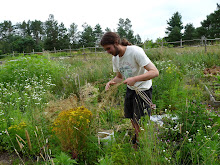
Apologies for the lack of posts lately, although there isn't much exciting news coming from the garden this time of year there are still lots of projects on the go. Now that the harvest is all in I've been tallying the crop and writing the 2010 seed catalogue, I hope to have it up on the website in November. I have about 5 times last year's quantities and twice the number of varieties available (with many more grown in small amounts on track for the 2011 catalogue).
Aside from the seed work I'm beginning to focus once again on the forest, I'm working to remove the conifer seedlings from a two acre logged area so to encourage the growth of mixed hardwoods in this patch. The plan is to manage the hardwoods as a coppice, that is cut on a regular and continueous cycle of harvesting and regrowth. The trees send out many new shoots from the stump and when cut as 10 or 15 year old poles they aren't injured. Indeed they can have their life spans greatly increased, basically by being kept in a state of continueous youth. What's most appealing to me is that it's a style of forestry totally human scaled, the trees are cut at a size where they're managable without any machinery, all that's needed for harvesting and working are a few basic hand tools (billhook, machete, axe, bow saw, froe...). This regular cutting creates an interesting symbiosis between the coppice ecosystem and humans. I sometimes think of it as similar to mowing a wild meadow of grasses and wildflowers, both the coppice and the meadow can be cut in a human scaled and sensitive way to provide for us without damaging the ecology of the site.
I also want to mention the new community garden being set up in Middleton. There's been talk going on for a little while but the town council is now on board and we're in the process of selecting and clearing a site. I've been informally appointed the lead garden consultant for the project, the other day I checked out the four proposed sites with the others involved and we all agreed on the old field next to the ice rink (you need to be from Middleton!). It's a central location in town with fertile clay-loam soil and there's a path along side that connects to Main Street. I can invision a sign and an arbour directing people to the bountiful eden behind the trees. That's still a ways away though, we're hoping to get it cleared and plowed before the ground freezes so we can get everyone planting next spring.
Today was the International Day of Climate Action (www.350.org) and in observance I mowed a second "350" in the wet, soggy clover. The rain was too heavy to get photos so I'll post a photo and a better write-up in a day or two...
Showing posts with label organic growing. Show all posts
Showing posts with label organic growing. Show all posts
Saturday, October 24, 2009

Wednesday, June 3, 2009
Lots to update on
I'm finally able to do some writing again after a solid month of garden and farm work. With the help of our WWOOFer Bjoern I got both the seed and food gardens planted weeks ahead of schedule. This year we've got over 60 bean varieties on the go, 40 peas and about 40 tomatoes, among many others. A few of the beans are my own strains that I'm working towards stabilizing. My most promising of these is a striped variation of the pole bean McGrath's Africa. Two years ago in our McGrath's Africa patch I discovered a plant that produced black and white striped seeds in striped green pods, rather than the usual white seeds in leathery purple pods. Last year I grew them out and 95 percent stayed true to type (which is a great rate). If I can stabilize it for a few more years I might even be able to release it as new variety, any name suggestions?
We also planted an acre of Sorghum x Sudangrass in the newly cleared upper field as a green manure crop. Without the ideal equipment of a harrow and some power source to pull it (animal or machine) I ended up broadcast seeding it and then zipping over the field with the rototiller set to it's fastest speed. I set the tines very shallow so that it only mixed the top two inches or so of soil, it worked almost like a rake. A small corner of the upper field we've enriched with tons of manure and we've planted sunflowers, tomatoes, peppers, adzuki beans, chickpeas, millet and corn, as well as a huge patch of squash planted on mounds of manure. We're experimanting with these mounds as a way to stretch what little valuable manure we have. The roots of the squash will be growing in almost pure manure while the vines can sprawl over the less fertile soil around the mounds. We'll see how well it works.

Now that the garden is planted and Bjoern's keeping the weeds under control I'm starting to put some more time into the yurt. Last January I took a great yurt-building workshop held by Alex and Selene Cole of Little Foot Yurts over in the Gaspereau Valley. Over the winter I cut, peeled, shaped and cured the poles for the yurt, and starting now I'm trying (emphasis on trying) to get it assembled. If I'm sucessful, updates to follow...
 The yurt poles after we carried them in from the woods. Note the frames used for shaping the khana poles (wall poles).
We also planted an acre of Sorghum x Sudangrass in the newly cleared upper field as a green manure crop. Without the ideal equipment of a harrow and some power source to pull it (animal or machine) I ended up broadcast seeding it and then zipping over the field with the rototiller set to it's fastest speed. I set the tines very shallow so that it only mixed the top two inches or so of soil, it worked almost like a rake. A small corner of the upper field we've enriched with tons of manure and we've planted sunflowers, tomatoes, peppers, adzuki beans, chickpeas, millet and corn, as well as a huge patch of squash planted on mounds of manure. We're experimanting with these mounds as a way to stretch what little valuable manure we have. The roots of the squash will be growing in almost pure manure while the vines can sprawl over the less fertile soil around the mounds. We'll see how well it works.

Now that the garden is planted and Bjoern's keeping the weeds under control I'm starting to put some more time into the yurt. Last January I took a great yurt-building workshop held by Alex and Selene Cole of Little Foot Yurts over in the Gaspereau Valley. Over the winter I cut, peeled, shaped and cured the poles for the yurt, and starting now I'm trying (emphasis on trying) to get it assembled. If I'm sucessful, updates to follow...
 The yurt poles after we carried them in from the woods. Note the frames used for shaping the khana poles (wall poles).
Monday, April 20, 2009
Spring Update
Has a lot ever happened so far this spring! It's been so busy I haven't had time to write about it. It's kind of funny, in the winter I have lots of time but nothing to write about while in the spring I have everything to write about but no time to do it!


The seeds are still selling and I'm sold out of about 3/4 of the catalog. It seems like every week this time of year there's another Seedy Saturday somewhere in the province. Most recently was Halifax and before that was the very successful one in Wolfville. This could be the busiest time of year around here just because I'm still doing my seed rounds while at the same time the garden is coming back to life and the rest of the farm needs work as well. In the garden the garlic has sprouted and Colin has planted the first peas.


An exciting recent discovery is that the old chicken run is built on top of what's best descibed as an ancient manure deposit. I think what happened is that the previous several owners simply swept the manure out the back door of the barn until over the decades it built up into this incredible four foot deep pile of fertile black earth. I've spread over 100 wheel-barrow loads over the garden so far with lots still remaining. When the pile is gone we'll build a much larger and sturdier run to contain both the chickens and goats for the summer. The chickens currently have the run of the farm, scratching in the forest, raised beds and compost piles and dust bathing en masse along the warm foundation of the house. They can't complain too much about their new summer enclosure, at several thousand square feet it would be paradise for the average battery-hen.
We're having the newly cleared upper field plowed for the first time in a few weeks. After the roots are raked out and we get some manure spread to enrich the poor sandy soil we hope to grow some seed and food crops up there this year. What's good about having two seperate fields like this is that we can isolate crops like squash and corn for producing seed. My plan with squash is to plant them on hills of manure which should make that limited resource go further. We'll just have the root-zone heavily enriched while the vines can sprawl over the poorer soil. I'll plant about an acre of alfalfa in the upper field this spring as a long-term green manure crop. The deep roots bring up nutrients from the sub-soil while at the same time fixing nitrogen. What the field really needs though is more organic matter. The hope is that the alfalfa will produce enough biomass that we can mow it several times a year to add to the soil. I suppose we'll see how it goes.
Bessie is really enjoying being out on the pasture again. Although not much is growing yet you can tell she loves being out of the barn. We think she'll be giving birth any day now. Stay tuned...

Friday, February 13, 2009
Edemame Soybeans
Although it's freezing cold today, it's nice to think about the garden that will be flourishing in just a few more months. Here's a little article I recently wrote on a favourite crop of mine that I feel should be far more widely grown in Nova Scotia:
 Edemame soybeans are both one of my favourite vegetable crops and one that’s very under-utilized. Unlike the more common beige soybeans that are usually used for tofu and animal feed, edemame soybeans have been bred for flavour and are picked fresh when they’re plump in their pods like peas. They’re much more popular in Asia where the way to prepare them is to steam them lightly (one minute if fresh, 3-4 if frozen), before popping the seeds directly into your mouth one by one. The ultimate slow food! Like all vegetables really, the difference in taste between edemames fresh from your garden and the frozen ones from a bag (grown in China) is incomparable. It’s a mystery to me why all the store-bought edemame soybeans are from China when they’re so well adapted to growing across so much of Canada.
The soybean plant grows to about thigh height on good soil, depending on the particular variety. Being legumes, soybeans fix nitrogen which allows them to grow on poor soils. However, like all vegetables you’ll have much better results planting them in healthy, fertile soil. They like heat but nothing we can't provide in the Maritimes. If you can grow beans or corn in your area you can grow soybeans! They’re more drought tolerant than most other plants and they shouldn’t need any watering after they’re established. I plant mine in early June after the last frost in wide rows (multiple rows in a strip between walkways, as opposed to single rows) which creates a dense canopy of foliage that shades out weeds. Planting father apart would give a higher yield per plant and a similar yield overall, but without the weed suppression that a dense planting provides. If you have limited seeds you might prefer a wider spacing than me. The pods should be ready to harvest in late August. The seeds should be plump but not overripe (think a perfectly ripe pea pod).
I really think that edemame soybeans deserve to take their place alongside the more common vegetables in Canada. They grow so well in our climate that it’s insane that we should have to import them from the other side of the planet from a country with such a suspect record of food safety. There's no better place to get the ball rolling than in your own garden!
Aside from me of course here are a few Canadian seed sources of edemame soybeans:
Salt Spring Seeds (http://www.saltspringseeds.com/)
Prairie Garden Seeds (http://www.prseeds.ca/)
Heritage Harvest Seed (http://www.heritageharvestseed.com/)
Mapple Farm (email: winggate@nbnet.nb.ca)
 Edemame soybeans are both one of my favourite vegetable crops and one that’s very under-utilized. Unlike the more common beige soybeans that are usually used for tofu and animal feed, edemame soybeans have been bred for flavour and are picked fresh when they’re plump in their pods like peas. They’re much more popular in Asia where the way to prepare them is to steam them lightly (one minute if fresh, 3-4 if frozen), before popping the seeds directly into your mouth one by one. The ultimate slow food! Like all vegetables really, the difference in taste between edemames fresh from your garden and the frozen ones from a bag (grown in China) is incomparable. It’s a mystery to me why all the store-bought edemame soybeans are from China when they’re so well adapted to growing across so much of Canada.
The soybean plant grows to about thigh height on good soil, depending on the particular variety. Being legumes, soybeans fix nitrogen which allows them to grow on poor soils. However, like all vegetables you’ll have much better results planting them in healthy, fertile soil. They like heat but nothing we can't provide in the Maritimes. If you can grow beans or corn in your area you can grow soybeans! They’re more drought tolerant than most other plants and they shouldn’t need any watering after they’re established. I plant mine in early June after the last frost in wide rows (multiple rows in a strip between walkways, as opposed to single rows) which creates a dense canopy of foliage that shades out weeds. Planting father apart would give a higher yield per plant and a similar yield overall, but without the weed suppression that a dense planting provides. If you have limited seeds you might prefer a wider spacing than me. The pods should be ready to harvest in late August. The seeds should be plump but not overripe (think a perfectly ripe pea pod).
I really think that edemame soybeans deserve to take their place alongside the more common vegetables in Canada. They grow so well in our climate that it’s insane that we should have to import them from the other side of the planet from a country with such a suspect record of food safety. There's no better place to get the ball rolling than in your own garden!
Aside from me of course here are a few Canadian seed sources of edemame soybeans:
Salt Spring Seeds (http://www.saltspringseeds.com/)
Prairie Garden Seeds (http://www.prseeds.ca/)
Heritage Harvest Seed (http://www.heritageharvestseed.com/)
Mapple Farm (email: winggate@nbnet.nb.ca)
Saturday, January 10, 2009
A New Mindset on Soil
More than anything else, the primary role of the organic grower should be to nurture a healthy and fertile soil. As long as the soil is healthy it will produce healthy plants that will proliferate with few other inputs from their human caretakers.
Agricultural and garden soil is really an ecosystem unto itself, but one that could be thought of as having a symbiotic relationship with humans. Unlike the soils of undisturbed forests or meadows, which, since the last ice-age, have been steadily increasing in organic matter and biodiversity, garden soils don’t have a constant source of fallen leaves, dead wood, or grass roots to decompose and add fertility and humus. To avoid degrading the long term health of the soil in our efforts to grow our species’ favoured plants, we need to make an attempt to replicate these soil building systems ourselves.
In any natural ecosystem, organic matter is primarily produced by plants at the point of photosynthesis and eventually added to the soil as they decompose. Without disturbance, these systems would continue increasing the soil fertility indefinitely. Because through agriculture we have replaced the natural order of things that kept the soil healthy, we can‘t just extract the biological wealth (existing humus) from the soil without also adding more biological wealth (compost, manure, leaves, straw, etc.) to replace it. Organic matter, in one source or another, should be added in regularly and in generous amounts. Especially on poor, already depleted soil it’s important to provide a boost of organic matter in order to get things started. In parts of Asia for example, the same farmland has been cultivated continuously for over 4,000 years and it’s perhaps more fertile now than it was at first. This is a major contrast from much of North America, were, in many cases, a few hundred years of human disturbance has left the once rich soil exhausted. This disparity is due in large part to the high emphasis in Asia on increasing organic matter in the soil through utilizing absolutely all available sources of organic matter and using lots of manure (both animal and human).
On our farm we produce quite a bit of manure from our animals, which we compost and spread in the garden after one year. All of our garden debris (stalks, vines, vegetable scraps etc.) is either composted or tilled directly into the garden, or in the case of vegetable scraps, fed to the goats and recycled into the garden through their manure. Leaves from the woods can be used for mulching and composting. We buy old hay from a local farm both for mulching and for animal bedding, which could be seen as bringing in fertility from elsewhere to improve the fertility here. Perhaps there is something to be said for that, but long term I’m aiming to have more of a closed circle of nutrients both generated and utilized on our farm, keeping everything fertile without needing to rob that fertility from another farm.
As well as regularly adding compost and other organic matter, a soil building practice we do a lot of is growing green manure crops to be tilled back into the soil. We try, as much as possible, to avoid having bare ground in the garden. Whenever there is no food crop to be grown, you may as well be using the space for growing organic matter in situ. We grow primarily buckwheat as a green manure in the summer, as well as oats and winter rye in the fall and winter.
I always notice a dramatic increase in earthworms and other soil life after we add any source of organic matter to our formerly depleted soil. Also dramatic is the response of plants to at last have a healthy, living soil to grow in. The areas of our garden that we have focused on enriching produce much hardier, self reliant plants. The scraggly Jerusalem artichokes that we inherited with the farm grew to eight feet last year after having compost spread over them, while the half of their bed that didn’t receive the compost grew to a mere two feet.
When you think about it, soil is one of the most crucial resources that we require to survive. The foot or so of topsoil that covers the world’s agricultural areas is what our species is totally dependent on to produce food. It took thousands of years of natural processes for that vital resource to develop, so it’s of tremendous importance not only to preserve but to enrich what we have left. A mere handful of healthy soil has countless billions of individual micro-organisms, consisting of thousands of species ranging from bacteria to fungi to nematodes. This is why it's important to think of soil as an ecosystem rather than simply as a medium for growing plants. When any ecosystem is healthy all of it’s species have the opportunity to thrive, in this case that includes our garden plants.
This gardening philosophy is a quite a shift from the predominant mindset that got us into so many of the ecological problems we’re dealing with today, the view that we should have total control over the ecosystems in which we live and that all life in the garden other than our cultivated plants are enemies and competition to be destroyed. That’s an outlook on nature that we’re going to have to collectively overcome, for the sake of all life on earth, the sooner the better.
 A soil building green manure crop of buckwheat. I scythe it down late in its flowering period to be tilled into the soil.
Agricultural and garden soil is really an ecosystem unto itself, but one that could be thought of as having a symbiotic relationship with humans. Unlike the soils of undisturbed forests or meadows, which, since the last ice-age, have been steadily increasing in organic matter and biodiversity, garden soils don’t have a constant source of fallen leaves, dead wood, or grass roots to decompose and add fertility and humus. To avoid degrading the long term health of the soil in our efforts to grow our species’ favoured plants, we need to make an attempt to replicate these soil building systems ourselves.
In any natural ecosystem, organic matter is primarily produced by plants at the point of photosynthesis and eventually added to the soil as they decompose. Without disturbance, these systems would continue increasing the soil fertility indefinitely. Because through agriculture we have replaced the natural order of things that kept the soil healthy, we can‘t just extract the biological wealth (existing humus) from the soil without also adding more biological wealth (compost, manure, leaves, straw, etc.) to replace it. Organic matter, in one source or another, should be added in regularly and in generous amounts. Especially on poor, already depleted soil it’s important to provide a boost of organic matter in order to get things started. In parts of Asia for example, the same farmland has been cultivated continuously for over 4,000 years and it’s perhaps more fertile now than it was at first. This is a major contrast from much of North America, were, in many cases, a few hundred years of human disturbance has left the once rich soil exhausted. This disparity is due in large part to the high emphasis in Asia on increasing organic matter in the soil through utilizing absolutely all available sources of organic matter and using lots of manure (both animal and human).
On our farm we produce quite a bit of manure from our animals, which we compost and spread in the garden after one year. All of our garden debris (stalks, vines, vegetable scraps etc.) is either composted or tilled directly into the garden, or in the case of vegetable scraps, fed to the goats and recycled into the garden through their manure. Leaves from the woods can be used for mulching and composting. We buy old hay from a local farm both for mulching and for animal bedding, which could be seen as bringing in fertility from elsewhere to improve the fertility here. Perhaps there is something to be said for that, but long term I’m aiming to have more of a closed circle of nutrients both generated and utilized on our farm, keeping everything fertile without needing to rob that fertility from another farm.
As well as regularly adding compost and other organic matter, a soil building practice we do a lot of is growing green manure crops to be tilled back into the soil. We try, as much as possible, to avoid having bare ground in the garden. Whenever there is no food crop to be grown, you may as well be using the space for growing organic matter in situ. We grow primarily buckwheat as a green manure in the summer, as well as oats and winter rye in the fall and winter.
I always notice a dramatic increase in earthworms and other soil life after we add any source of organic matter to our formerly depleted soil. Also dramatic is the response of plants to at last have a healthy, living soil to grow in. The areas of our garden that we have focused on enriching produce much hardier, self reliant plants. The scraggly Jerusalem artichokes that we inherited with the farm grew to eight feet last year after having compost spread over them, while the half of their bed that didn’t receive the compost grew to a mere two feet.
When you think about it, soil is one of the most crucial resources that we require to survive. The foot or so of topsoil that covers the world’s agricultural areas is what our species is totally dependent on to produce food. It took thousands of years of natural processes for that vital resource to develop, so it’s of tremendous importance not only to preserve but to enrich what we have left. A mere handful of healthy soil has countless billions of individual micro-organisms, consisting of thousands of species ranging from bacteria to fungi to nematodes. This is why it's important to think of soil as an ecosystem rather than simply as a medium for growing plants. When any ecosystem is healthy all of it’s species have the opportunity to thrive, in this case that includes our garden plants.
This gardening philosophy is a quite a shift from the predominant mindset that got us into so many of the ecological problems we’re dealing with today, the view that we should have total control over the ecosystems in which we live and that all life in the garden other than our cultivated plants are enemies and competition to be destroyed. That’s an outlook on nature that we’re going to have to collectively overcome, for the sake of all life on earth, the sooner the better.
 A soil building green manure crop of buckwheat. I scythe it down late in its flowering period to be tilled into the soil.
Subscribe to:
Posts (Atom)